How to Find Your Gothic Ring Size: The Complete Ring Sizing Guide for Statement Rings
To find your gothic ring size, measure your finger’s circumference in the evening with warm hands using a non-stretchy paper strip, convert the reading to a US size, and go half a size up for bands wider than 6 mm. This guide covers three measuring methods, a size conversion chart, and what to do when a ring arrives not fitting.
Why Gothic Rings Are Harder to Size Than Ordinary Rings
Gothic rings are not thin wedding bands. Skull, coffin, bat, and crossbones designs sit on wide, sculptural shanks — often 8 mm or more — and a wide band feels tighter than a narrow one at the exact same numerical size. The size that fits a slim ring can strangle your finger in a statement piece.
Most gothic rings are stainless steel: tough and tarnish-resistant, but practically impossible to resize. Getting the size right the first time is the whole game.
3 Accurate Ways to Measure Your Ring Size at Home
Method 1: The paper strip method
Cut a strip of plain paper roughly 10 cm long and 1 cm wide. Paper is the key detail — it does not stretch, so it will not quietly add millimetres the way fabric tape or elastic string does (about 1.3 mm of extra circumference is a full half size). Wrap it snugly around the base of the finger where you will wear the ring, mark the overlap, and measure that length in millimetres: about 52.8 mm is a US 6, 54.4 mm a US 7, 57 mm a US 8.
Two details make or break this method. First, the knuckle rule: if your knuckle is larger than the base of your finger, measure at the knuckle — the ring must clear it. Second, timing matters: fingers run smaller in the morning and in cold weather, larger in the evening and in warm rooms. Measure in the evening with warm hands, and repeat the measurement two or three times across the day if the ring cannot be resized.
Method 2: Measure a ring you already own
If you already own a ring that fits the target finger comfortably, this is the most reliable at-home method. Measure straight across the inside of the band — inner edge to inner edge, never the outside — and convert the diameter to circumference (multiply by 3.14): a 17.3 mm inner diameter gives about 54.4 mm, a US size 7. Note that every finger is its own size, and your dominant hand usually runs slightly larger.
Method 3: Use a plastic ring sizer set
Multi-size ring sizer sets cost a few dollars and work like the metal mandrels jewelers use. Try candidate sizes on the actual finger at the time of day you will usually wear the ring, and keep the test size on for a few minutes to check real comfort. If you buy several gothic rings online, this tiny purchase pays for itself with the first avoided return.
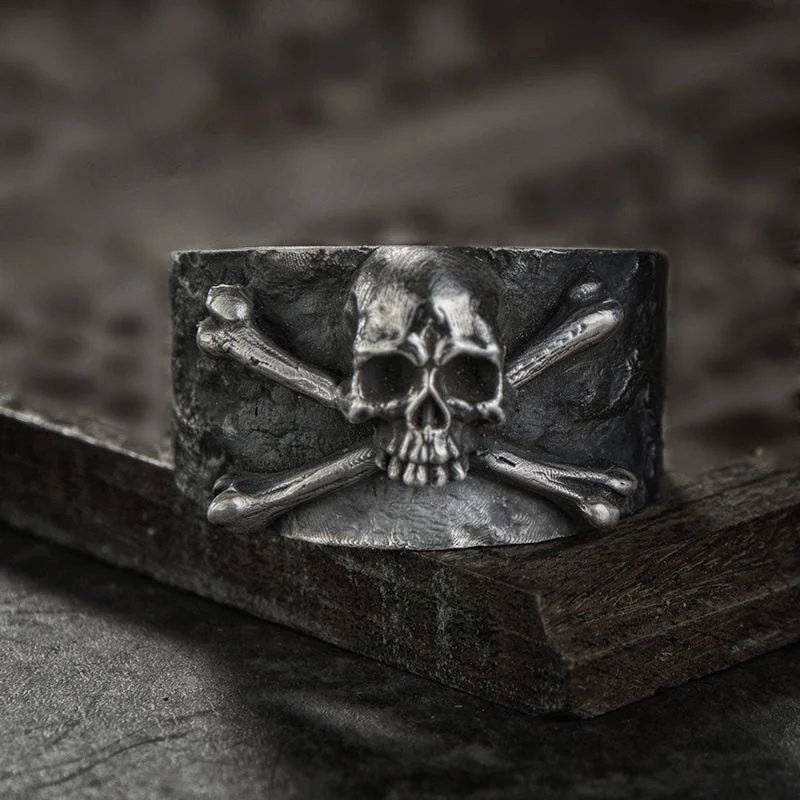
The Wide-Band Rule: Size Up for Statement Rings
Most gothic ring returns trace back to one buried rule: a wide band fits tighter than a narrow band of the same size. More metal means more surface contact, more pressure, and less room to flex. The guideline jewelers use:
- Bands under 4 mm: order your true measured size.
- Bands 6 mm and up — most skull, coffin, bat, and crossbones designs: order half a size larger than your measurement.
- Very chunky or sculptural rings with raised interior detail: consider a full size up, since the detailing eats into the inner diameter.
When your measurement falls between two sizes on a wide gothic ring, the larger one is the safer choice — a slightly loose ring stays on your hand, while a too-tight one stays in a drawer. Chunky statement pieces like the Men’s Crossbones Ring are exactly the designs this rule was made for.
5 Sizing Mistakes That Ruin Gothic Rings
- Measuring the wrong finger or hand. Always measure the exact finger, on the exact hand, where the ring will live.
- Ignoring the knuckle. Tapered fingers — slim base, larger knuckle — are the classic trap. Size for the knuckle the ring must pass over, not the base where it will rest.
- Measuring at the wrong time. Morning measurements and cold hands run small. Evening, warm hands, after a normal day — that is your true wearing size.
- Using a stretchy measure. Fabric tape and elastic string stretch as you pull, silently adding millimetres. Plain paper or a proper sizer set only.
- Treating wide bands like thin bands. Ordering your standard size in a chunky skull or coffin ring is the most common sizing complaint in gothic jewelry reviews.
Quick Conversion Chart: US, UK, and EU Ring Sizes
Makers list sizes in different systems, so keep this chart handy. All values are approximate inner circumferences.
| US size | Circumference (mm) | UK size | EU size |
|---|---|---|---|
| 6 | 51.9 | M 1/2 | 52 |
| 7 | 54.4 | O | 54 |
| 8 | 57.1 | Q 1/2 | 57 |
| 9 | 59.7 | S 1/2 | 60 |
| 10 | 62.3 | T 1/2 | 62 |
| 11 | 64.9 | V 1/2 | 65 |
| 12 | 67.4 | Y | 67 |
What If It Arrives and Doesn’t Fit?
Do not force it — a ring that needs forcing on will need cutting off. Because most gothic rings are stainless steel, a jeweler’s resize is usually off the table: stainless steel does not re-shape the way gold or silver does.
Your options, in order of practicality: exchange it for the corrected size (check the exchange policy before ordering — the cleanest fix); use a ring guard if it is only slightly too large — flexible plastic guards are cheap, invisible, and will not scratch the band; or choose an adjustable design next time. Open-shank designs like the Unisex Bat Ring can be gently flexed to fit, which removes sizing anxiety entirely.

Styling Note: Where Statement Rings Belong
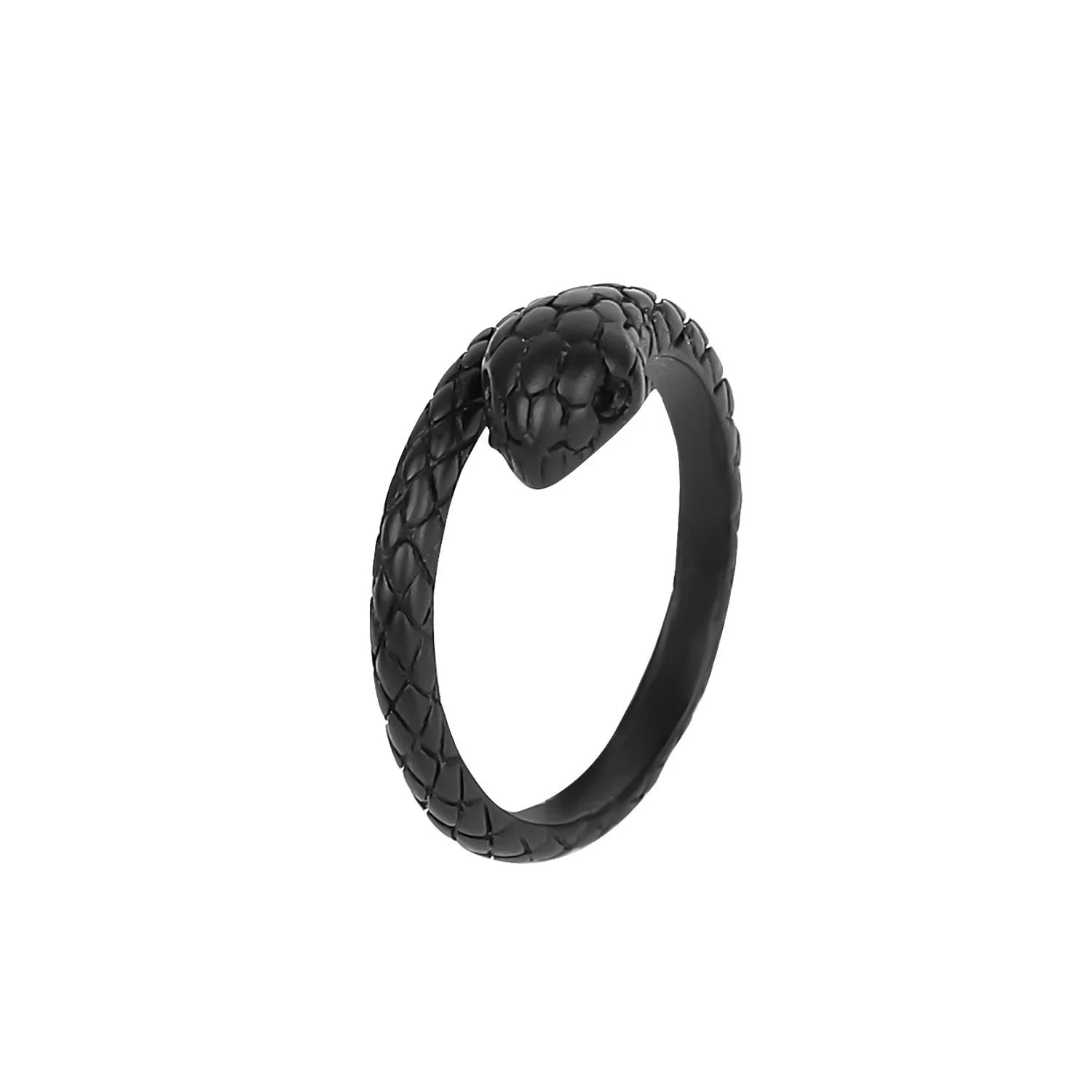
Once the fit is right, placement does the rest of the work. Wear one chunky ring per hand to let the design breathe — a coiled piece like the Snake Ring reads best on the middle or index finger, where its width has room. Stacked thin bands belong on adjacent fingers, never under a wide statement ring, where the combined bulk will feel — and fit — too tight.
FAQ: Gothic Ring Sizing
Should I size up for a skull ring?
Yes, in most cases. Skull, coffin, and crossbones rings typically have bands 6 mm or wider, and wide bands fit tighter than narrow ones. Order half a size up from your measured size for these designs.
What if my measurement falls between two sizes?
For wide gothic bands, take the larger size — fingers swell through the day. For thin bands under 4 mm, the smaller size usually works. Re-measure in the evening and trust the second reading.
Can stainless steel gothic rings be resized?
Generally no. Stainless steel cannot be cut and re-soldered the way gold or silver can, and sculpted details make alteration even harder. That is exactly why measuring carefully — and sizing up for wide bands — matters so much with gothic rings.