The Gothic Sizing Guide: How to Get the Perfect Fit in Goth Clothing
Do gothic clothes run small? Often, yes — alternative brands cut closer to real body measurements than mainstream vanity sizing, and many use Asian or unisex blocks one to two sizes smaller than US/EU labels. This guide shows you how to measure yourself in five minutes and know exactly when to size up or down in gothic tops and jeans.
Why Gothic Clothing Runs Small (and Why That Is Normal)
If you have ever ordered your usual size from a gothic shop and found you could not zip, button, or breathe in it, you are not alone. “Runs small” is one of the most repeated phrases in alternative-fashion reviews on Amazon and Reddit, and there are three structural reasons behind it.
First, many gothic brands skip mainstream vanity sizing: a high-street “medium” is cut generously, while an alternative brand’s medium matches actual medium measurements. Second, much gothic clothing uses Asian sizing blocks, typically one to two sizes smaller than US or EU equivalents. Third, gothic silhouettes are deliberately fitted — corset tops and skinny jeans are designed to sit close, with no forgiveness built in.
The community consensus, repeated across r/goth fit-check threads and hundreds of product reviews, is simple: never trust the letter on the tag. Trust the tape measure.
The 5-Minute Measurement Ritual (Do This Once, Keep It in Your Phone)
Take five minutes with a soft measuring tape before you order. Wear thin layers, keep the tape snug but not tight, and stand relaxed.
What to measure
- Bust/chest: around the fullest part, tape level across your back.
- Natural waist: the narrowest point of your torso, usually an inch or two above the navel.
- Hips: around the fullest part of your seat.
- Inseam: from the crotch seam to the ankle bone — critical for jeans you plan to stack over boots.
- Shoulder width: seam to seam across the back — the fastest way to judge whether a top will fit.
Save these numbers in a phone note, and compare them against the garment measurements on the size chart — how big the actual piece is — not just the “body size” column. That is the number that decides whether it fits.
Gothic Tops: Unisex vs. Fitted — Read the Cut Before the Size
Gothic tops split into two opposite worlds. Unisex and men’s-cut tees use a male block — broader shoulders, straighter waist, longer body — and often run boxy or large; size down for a fitted look. Women’s fitted tops, corset tops, and bustiers are cut close through bust and waist and run true to small; if you sit between sizes, size up.
Check the shoulder measurement and the length on the size chart — shoulders past the seam ruin the whole top, and cropped gothic tops vary wildly in how cropped they really are.
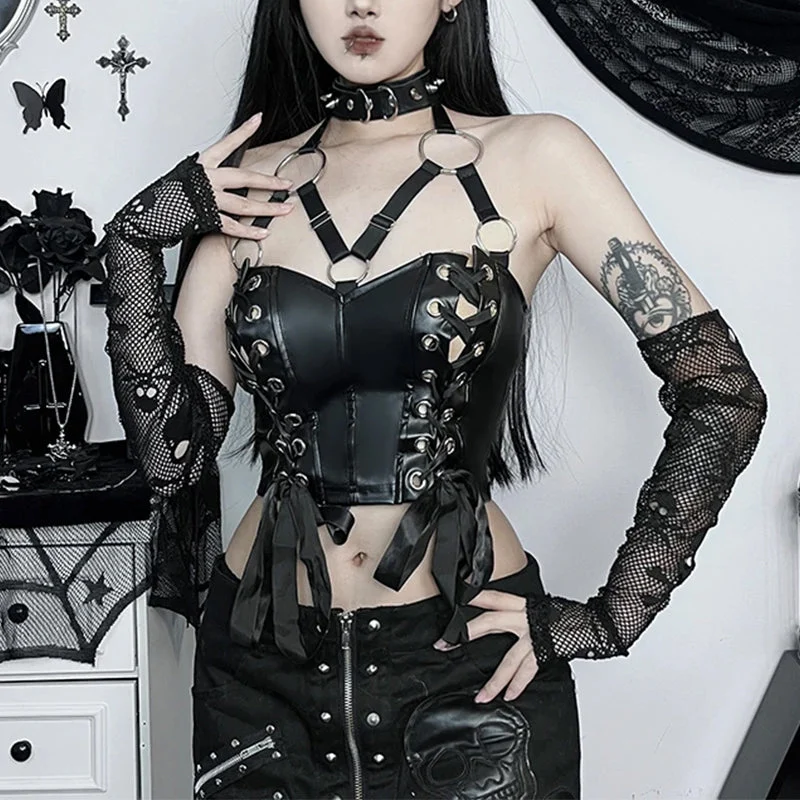
A fitted piece like the Women’s Gothic Top is a good test case: compare your bust to the garment’s bust measurement, and go up a size near the upper limit — a top that pulls across the chest ruins the neckline and the print at once.
Gothic Jeans: Your Waist Size Is a Suggestion, Not a Fact
Jeans are where sizing chaos peaks: a “32 waist” can measure 31 to 34 inches depending on brand, cut, and stretch, and gothic hardware changes how a pair sits. The experienced buyer’s fix: measure a well-fitting pair you own, laid flat and doubled, and shop by that number — not by the size printed inside your current jeans.
Rise matters as much as waist: high-rise pairs with cropped tops and corsets; low-rise sits on the hips and needs a belt under heavy buckles. Inseam decides whether jeans stack over platform boots or bunch at the ankle — measure it, don’t guess.
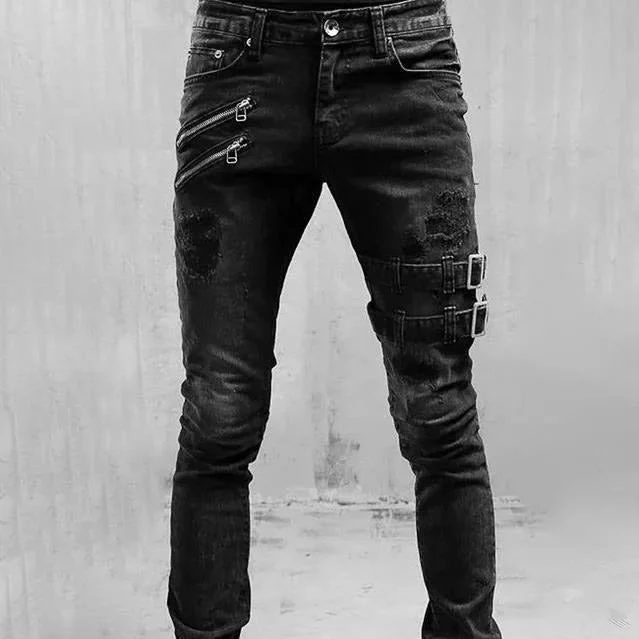
Hardware-heavy styles like Gothic Buckle Jeans deserve extra caution: buckles add zero stretch, so the waist must fit on its own. Between two sizes in non-stretch, hardware-loaded denim, take the larger — a belt hides a loose waist, but nothing hides a pair you cannot close.
Men’s Gothic Jeans and the “Size Up” Rule
Men’s and unisex gothic jeans add one twist: the Y2K baggy revival means many cuts are intentionally oversized — your normal size already gives the drape, and sizing up again turns “baggy” into “falling off.” Check the description for “relaxed,” “baggy,” or “oversized” before touching the size selector.
For skinny and straight cuts in rigid denim, the community rule holds: between sizes, size up. Stretch forgives half an inch; rigid denim forgives nothing. One Amazon-review lesson: black denim can feel tighter than the same cut in a lighter wash, because extra dye processing stiffens the fabric.
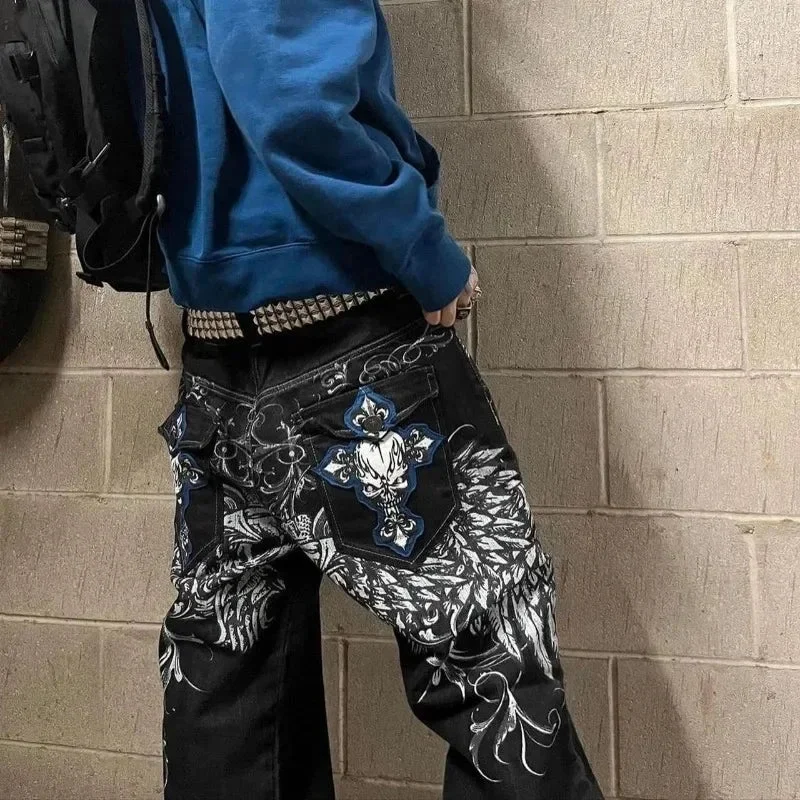
For the streetwear end of goth, Men’s Gothic Jeans in a straight or relaxed cut are the most forgiving entry point: the looser block tolerates measurement error, and prints sit better when fabric isn’t stretched to its limit.
The Size-Up / Size-Down Decision Chart
Pin this to your phone notes:
- Stretch fabric, true-to-size reviews → take your measured size.
- Non-stretch fabric, fitted cut, or Asian sizing block → size up.
- Unisex or men’s-cut tee, and you want it fitted → size down.
- Between sizes in bottoms → size up (belts fix loose waists; nothing fixes too-tight hips).
- Between sizes in tops → size up for fitted styles, either way for oversized-intended styles.
- Corset tops → ignore standard sizing entirely and follow a corset-specific guide (see below).
Golden rule from a decade of fit threads: when reviews mention fit, believe them over the chart. Ten reviewers saying “size up” beats any printed table.
What About Corsets, Chokers, Rings, and Hats?
Some gothic categories play by their own sizing rules, and we have covered each in depth:
- Corsets: sized by waist reduction and “seasoning,” not by S/M/L — see Your First Gothic Corset: The Beginner’s Buying Guide.
- Chokers: neck circumference plus a finger of slack — see How to Wear a Gothic Choker.
- Rings: measure your knuckle, not your finger base, especially for heavy skull rings — see How to Find Your Gothic Ring Size.
- Caps: one-size heads vary more than brands admit — see How to Wear a Gothic Cap.
FAQ
Do gothic clothes run small?
Often, yes. Many gothic brands use true-to-measurement or Asian sizing blocks with little vanity sizing, and fitted silhouettes are cut close by design. Compare your measurements to the chart’s garment measurements and read buyer reviews for fit notes.
Should I size up in gothic clothing?
Size up when the fabric has no stretch, the cut is fitted, the brand uses Asian sizing, or you fall between sizes in bottoms. Size down only when you want a fitted look in a unisex or men’s-cut tee. For everything else, your measured size is the right starting point.
How do I measure myself for gothic tops and jeans?
Soft tape over thin layers: bust at the fullest point, waist at the narrowest, hips at the fullest, inseam crotch to ankle, shoulder seam to seam. Save the numbers and shop by garment measurements, not your mainstream-store size.
6 Comments